Hurricane shutters lower insurance premiums in Florida more reliably than almost any other home improvement. Unlike cosmetic upgrades that add curb appeal but do nothing for your policy rate, shutters earn a documented insurance credit through your wind mitigation inspection. Florida law requires insurers to apply these credits, meaning the savings are guaranteed — not discretionary. Here is exactly how the savings work and what to do after installation to capture them.
How Wind Mitigation Inspections Work in Florida

Florida statute 627.0629 requires insurance companies to offer premium discounts for verified wind-resistant features on residential properties. This is not a suggestion — it is state law. Insurers must apply credits when a licensed inspector verifies that your home meets specific wind protection criteria documented on the official OIR-B1-1802 wind mitigation inspection form.
A licensed inspector completes the form by evaluating your home’s roof geometry, roof-to-wall connections, roof deck attachment, secondary water resistance, and opening protection. The opening protection section — Section 4 — is where hurricane shutters make their impact. The inspector photographs all shutters, verifies they carry a valid Florida Product Approval number, and confirms they cover every opening on the home.
The inspection takes about 30 minutes and costs $75 to $150, depending on your area and the inspector. That is a fraction of the annual savings it generates. Once complete, the inspection report is valid for five years and can be transferred if you switch insurance carriers during that period.
Your inspector will also check the product approval documentation for each shutter system. Florida Building Code requires that hurricane shutters carry a current Notice of Acceptance (NOA) or Florida Product Approval listing. Shutters purchased from a hardware store without proper FBC certification may not qualify for the insurance credit — even if they physically cover the opening.
What Shutter Types Qualify for Maximum Discounts
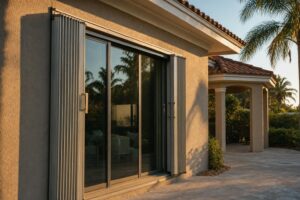
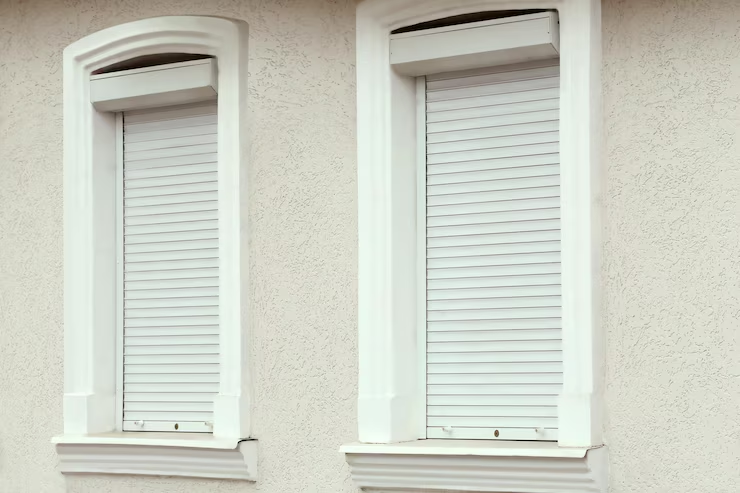
Not all shutters are created equal, but when it comes to insurance credits, most approved types earn the same discount. Accordion shutters, roll-down shutters, Bahama shutters, and colonial shutters all qualify for the “A” rating on the wind mitigation form when they cover all openings on the home. The “A” rating represents the highest level of opening protection and earns the maximum insurance credit.
Storm panels — the bolt-on aluminum or steel panels that are stored and deployed before each storm — also qualify for the same credit. However, there is an important requirement: the panels and all mounting hardware must be available on-site and accessible at the time of the wind mitigation inspection. If your storm panels are in a storage unit across town, the inspector cannot verify them and cannot award the credit.
The key requirement across all shutter types is the “large missile impact” rating. This means the product has been tested to withstand a 9-pound 2×4 lumber projectile traveling at 34 mph, followed by cyclic pressure testing that simulates sustained hurricane-force winds. This testing standard ensures the shutters can actually protect your home — not just cover the opening.
All openings on your home must be protected to earn the maximum discount. Windows, entry doors, sliding glass doors, skylights, and garage doors all count as openings. A single unprotected window — even a small bathroom window or laundry room window — downgrades your entire home from the “A” rating to “B” or “N,” which can mean losing hundreds of dollars in annual premium credits.
How Much You’ll Actually Save
Opening protection credits typically reduce the wind portion of your homeowner’s insurance premium by 15% to 45%, depending on your insurance carrier and the specifics of your policy. In Southwest Florida, wind coverage makes up 50% to 70% of your total premium, so the credit applies to a large portion of what you pay.
On a typical Fort Myers homeowner’s policy of $3,000 to $5,000 per year, opening protection credits translate to $400 to $1,500 in annual savings. The exact amount depends on your carrier, your home’s value, its proximity to the coast, and the other wind mitigation features present (roof type, connections, secondary water barrier).
Combined with other wind mitigation features — hip roof geometry, hurricane straps at roof-to-wall connections, and a secondary water resistance barrier — total wind mitigation savings can exceed $2,000 per year. Shutters alone are typically the single largest credit available on the form, but stacking multiple features produces the biggest overall savings.
The savings are recurring every single year. Shutters installed today will lower your premiums for the life of the product, which can be 20 years or more for quality accordion and roll-down systems. Over a 15-year period, $800 per year in savings adds up to $12,000 — more than the cost of most shutter installations.
Steps to Take After Shutter Installation
Schedule a wind mitigation inspection within two weeks of installation. Do not wait until your policy renewal date — the sooner you submit an updated wind mitigation report to your insurer, the sooner your premium decreases. Many carriers will issue a mid-term premium adjustment or credit once they receive the new report.
A wind mitigation inspection after shutter installation can save you hundreds annually — Bassine Insurance Agency in Fort Myers can re-quote your policy after installation to ensure you capture the full credit. Working with an independent insurance agent who represents multiple carriers helps you find the best rate that reflects your updated wind mitigation report.
Keep your product approval documentation and installation invoice in a safe, accessible location. Your insurer may request these documents to verify the shutter specifications, especially if your wind mitigation report references product approval numbers. Having the paperwork ready prevents delays in processing your premium credit.
If you change insurance carriers in the future, your wind mitigation report transfers with you. It is valid for five years regardless of which company insures your home. When shopping for new coverage, provide the wind mitigation report upfront so the quoting carrier includes the credits in their initial pricing.
Common Mistakes That Cost You the Discount
The most common mistake homeowners make is installing shutters on windows but forgetting the garage door. The garage door is typically the largest opening on a home, and leaving it unprotected downgrades your entire opening protection rating from “A” to “B” or “N.” Impact-rated garage doors or garage door shutter systems are available specifically for this purpose.
Buying non-rated shutters from a hardware store is another costly error. Decorative or non-tested panels may physically cover a window, but they do not carry the Florida Product Approval needed for the insurance credit. Your wind mitigation inspector will check the product approval number — and shutters without one will not count.
Not getting re-inspected after installation is surprisingly common. Your current wind mitigation report reflects your home’s condition at the time of the last inspection. New shutters are not automatically added to an existing report — you need a new inspection to document the updated protection and capture the credit.
Finally, letting your wind mitigation report expire costs you the discount. Most insurers require a current report — defined as within five years — to maintain the premium credits. Set a calendar reminder for four and a half years after your inspection to schedule a renewal before the report lapses.
Frequently Asked Questions
How long does it take to get insurance savings after installing hurricane shutters?
After installation, schedule a wind mitigation inspection (1-2 weeks to book), then submit the report to your insurer. Most carriers process the credit within 30 days. Some apply a mid-term adjustment, while others apply it at your next renewal. Total timeline from installation to savings: 4 to 8 weeks.
Do hurricane shutters increase home resale value?
Yes. Homes with full opening protection command higher prices in Southwest Florida’s real estate market. Buyers value both the storm protection and the documented insurance savings. Hurricane shutters are consistently cited by Florida real estate agents as a top-value home improvement.
Can I install hurricane shutters myself and still get the insurance credit?
The shutters themselves must carry a valid Florida Product Approval, regardless of who installs them. However, improper installation can void the product’s certification and cause the inspector to deny the credit. Professional installation ensures the shutters are mounted correctly and that all product approval requirements are met.
Ready to lower your insurance premiums with hurricane shutters? Hurricane Shutter Co. has been protecting Lee County homes since 1979. Call (239) 466-7577 for a free estimate, and we will help you calculate your projected insurance savings based on your home’s specific features.
Related Hurricane Protection Services
Explore the service pages and buying resources most closely tied to this topic.