Updated for the 2026 hurricane season. Choosing the best hurricane shutters for your Florida home starts with understanding what is available, what meets current building codes, and what fits your budget and lifestyle. At Hurricane Shutter Company in Fort Myers, we have been helping Southwest Florida homeowners make this decision since 1979 — and the right choice depends on your property, your comfort level with deployment, and how much you want to invest in long-term storm protection.

This guide breaks down the major shutter types, materials, installation considerations, and maintenance requirements so you can make an informed decision before hurricane season arrives.
Understanding the Different Types of Hurricane Shutters
The best hurricane shutters for your home depend on factors like window size, how quickly you need to deploy them, and whether you want a permanent or removable solution. Here are the most common types we install across Fort Myers, Cape Coral, Bonita Springs, and Estero:
1. Roll-Down Shutters: These retract into a compact aluminum housing above your window and deploy with a hand crank or motorized remote control. Roll-down shutters are the most convenient option — motorized versions deploy at the push of a button, which is critical when a storm approaches quickly. They provide excellent protection and are permanently mounted, so there is nothing to store or assemble. Roll-down shutters are the premium choice and are especially popular for large openings and high-end homes.
2. Accordion Shutters: These unfold horizontally from tracks on either side of your window or door. Accordion shutters are permanently mounted, easy to deploy without tools, and lock securely with thumbscrews or barrel bolts. They are one of the most popular choices in Southwest Florida because they offer strong protection at a mid-range price point. A single person can deploy accordion shutters across an entire home in under 30 minutes.
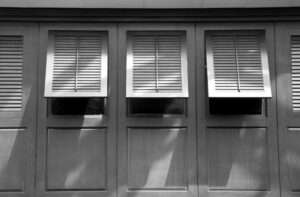
3. Bahama Shutters: Mounted above windows on hinges, bahama shutters prop open at an angle for everyday shade and ventilation, then lock closed for storm protection. They add a distinctive tropical aesthetic to your home and are always in place — no deployment or storage required. Bahama shutters are an excellent choice when you want protection that also enhances your home’s curb appeal.
4. Colonial Shutters: These decorative shutters mount on either side of your windows and swing closed when needed. Like bahama shutters, colonials combine style with function and are permanently attached. They suit traditional home designs and provide reliable wind protection when properly installed.
5. Storm Panels: Removable corrugated panels made from aluminum, steel, or clear polycarbonate that bolt or slide into tracks over your windows. Storm panels are the most affordable option and provide strong protection, but they require more time and effort to install — and you will need storage space for them when they are not in use. For homeowners on a budget, storm panels deliver excellent value.
6. Roll Down Screens: Similar to roll-down shutters but made with hurricane-rated mesh fabric instead of solid aluminum. Roll down screens offer storm protection while also providing insect screening, UV filtering, and privacy. They are a versatile multi-purpose product especially popular for lanai and patio enclosures.
Evaluating Material Options and Durability
The material your hurricane shutters are made from directly affects their strength, lifespan, and maintenance requirements. In Southwest Florida’s salt-air environment, material choice matters more than in most other regions.
Aluminum: The most common material for hurricane shutters in Florida. Aluminum is lightweight, strong, corrosion-resistant, and meets all Florida Building Code requirements. The majority of accordion shutters, roll-down shutters, bahama shutters, and storm panels we install are extruded aluminum. Look for shutters with a powder-coated or anodized finish for maximum durability in coastal conditions.
Steel: Heavier and stronger than aluminum, steel panels provide maximum impact resistance. However, steel is more susceptible to rust in coastal environments and requires more maintenance. Steel storm panels are a good choice for commercial properties or areas with extremely high wind exposure.
Polycarbonate (Clear Panels): Clear polycarbonate storm panels allow natural light into your home during a storm — a significant advantage during extended power outages. They are shatter-resistant and meet Florida building codes, though they tend to be more expensive than aluminum panels.
When evaluating durability, check the product’s Miami-Dade NOA (Notice of Acceptance) rating and its Design Pressure (DP) rating. These certifications verify that the shutters have been tested against specific wind speeds and impact forces. In Lee County, your shutters must meet the wind-load requirements specified by local building codes — your installer should provide documentation confirming compliance.
Why Professional Installation Matters in Florida
In Florida, hurricane shutter installation is not a typical DIY project. Here is why professional installation is the recommended approach — and often the required one:
Building codes and permits: Lee County and most Southwest Florida municipalities require permits for hurricane shutter installation. The work must be performed or supervised by a licensed contractor, and installations are subject to inspection. An improperly installed shutter can fail during a hurricane and may void your homeowner’s insurance coverage.
Structural assessment: Professional installers evaluate the condition of your window frames, wall structure, and mounting surfaces before installation. Shutters mounted into deteriorated concrete block, rotted wood, or improperly anchored frames can tear free during a storm.
Custom fabrication: Every window and opening is a different size. Professional contractors take precise measurements and have shutters custom-fabricated to fit your specific openings. Off-the-shelf products rarely provide adequate coverage or code compliance.
As a Florida Certified General Contractor (License #CGC1506749), Hurricane Shutter Company handles every aspect of installation — measuring, permitting, fabrication, installation, and final inspection. We never subcontract our work and we are licensed in Lee, Charlotte, and Collier counties.
Maintenance Tips for Long-Lasting Hurricane Shutters
Once you have chosen and installed the best hurricane shutters for your home, regular maintenance ensures they perform when you need them most. Here is what we recommend based on over four decades of experience in Southwest Florida:
1. Clean regularly: Wash shutters monthly with mild soap and warm water. Salt deposits from Gulf air accelerate corrosion if left unchecked. Pay attention to tracks, hinges, and areas where moisture collects.
2. Inspect for damage: After every major storm — and at minimum once a year before hurricane season (June 1) — inspect for cracks, dents, loose fasteners, or corrosion. Address issues immediately rather than waiting. Read our full guide on accordion hurricane shutter maintenance for detailed steps.
3. Lubricate moving parts: Accordion, roll-down, and manual screen shutters have wheels, rollers, and gears that need lubrication. Use a dry silicone spray — never WD-40 or oil-based products, which attract grime in coastal environments.
4. Operate monthly: Open and close your shutters every month, even outside hurricane season. This prevents mechanisms from seizing and allows you to catch problems early.
5. Store removable panels properly: If you use storm panels, store them vertically in a dry, protected area. Label each panel by window for faster deployment.
How Much Do Hurricane Shutters Cost in Fort Myers?
Hurricane shutter pricing varies significantly based on the type, material, number of openings, and whether motorization is included. As a general guide for Southwest Florida in 2026:
Storm panels: The most affordable option, starting around $7-$15 per square foot installed.
Accordion shutters: Mid-range pricing, typically $15-$30 per square foot installed.
Bahama shutters: $20-$35 per square foot installed, depending on size and finish.
Roll-down shutters (manual): $25-$45 per square foot installed.
Roll-down shutters (motorized): $35-$65 per square foot installed.
These are estimates — every home is different. The best way to get an accurate quote is to schedule a free in-person consultation. We measure your openings, discuss your priorities, and provide a detailed written estimate with no obligation. Visit our hurricane shutter cost guide for more pricing details.
Conclusion
Choosing the best hurricane shutters means matching the right product to your home, your budget, and your comfort with deployment. Whether you opt for the convenience of motorized roll-down shutters, the reliability of accordion shutters, or the affordability of storm panels, the most important thing is that your shutters are professionally installed, code-compliant, and properly maintained.
Hurricane Shutter Company has been protecting Fort Myers and Southwest Florida homes since 1979. We are BBB A+ rated, licensed as a Florida Certified General Contractor (CGC1506749), and we handle everything in-house. Contact our hurricane shutter company in Fort Myers today at (239) 466-7577 to schedule your free in-home consultation.
Related Hurricane Protection Services
Explore the services and local pages most closely connected to this topic.
- All Hurricane Shutters
- Accordion Shutters
- Roll Down Shutters
- Bahama Shutters
- Storm Panels
- Roll Down Screens
- Hurricane Shutter Cost Guide
Need help choosing the right solution? Call (239) 466-7577 for a consultation.
Frequently Asked Questions
How do homeowners choose the right hurricane shutter system?
The right system depends on the opening size, desired convenience, budget, appearance goals, and how often the homeowner expects to deploy the protection.
Should hurricane shutters be inspected every year?
Yes. Annual inspections help spot wear, loose hardware, track issues, and finish damage before a storm creates an emergency repair situation.
Can a local estimate help compare product options more accurately?
Absolutely. A field measurement and product walkthrough make it easier to compare shutters, screens, and panels based on the home's real openings and storm exposure.